The Multidisciplinary Penalty: Why Standard HR Rubrics Filter Out Great Embedded Engineers
Invalid Date · Lance Harvie
The job description reads like a wish list drafted by a committee that has never actually seen a microcontroller: “Seeking Senior Firmware Engineer. Must have 10+ years of experience in C, 8 years in Python, 5 years in Rust, expertise in AWS, proficiency with React for internal dashboards, and a deep understanding of analog circuit design. Experience with Yocto and Zephyr required. Knowledge of PCIe and USB 3.2 protocol analyzers is a plus.”
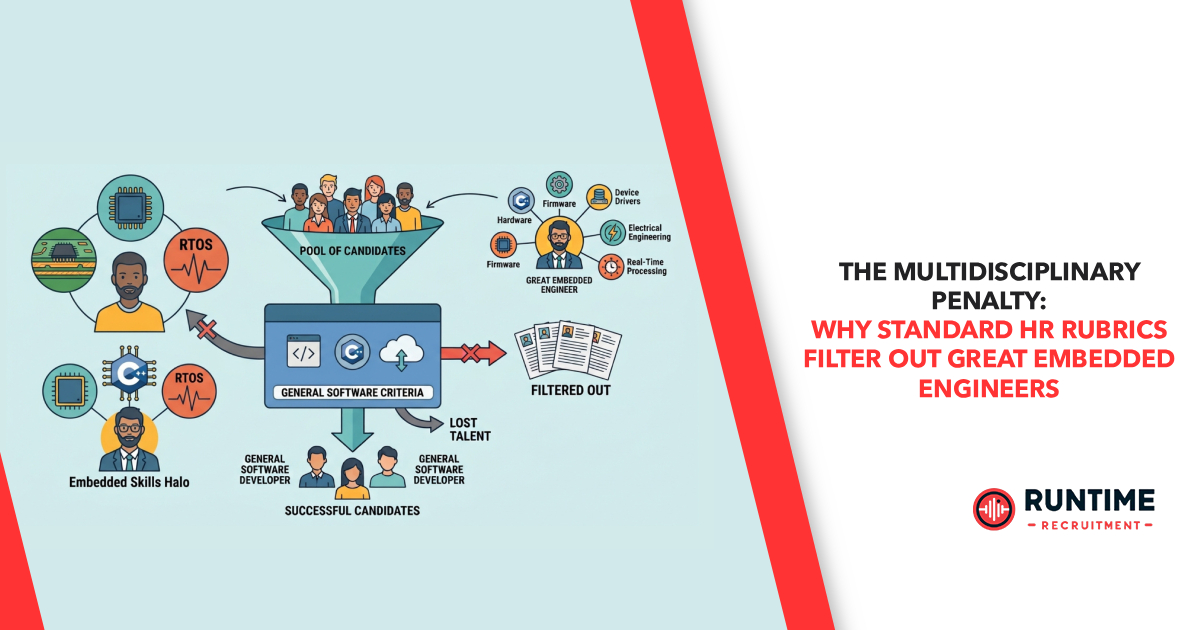
Any seasoned embedded engineer reading this will recognize the problem immediately. It is not that this individual does not exist—though the combination is vanishingly rare—it is that the process used to create this description, and the filters used to screen for it, are fundamentally broken. We are witnessing what can only be described as the Multidisciplinary Penalty: a systemic bias in standard HR and talent acquisition rubrics that actively penalizes the very skill set that makes embedded engineers exceptional.
Embedded systems engineering is, by definition, a T-shaped discipline. The vertical bar of the “T” represents deep, hard-won expertise in low-level software, real-time operating systems, or digital hardware. The horizontal bar represents a terrifyingly broad understanding of everything else: electronics, physics, mechanical constraints, supply chain limitations, compiler behavior, and often the business logic of the product itself. To be a great embedded engineer is to be a translator between the abstract world of software and the unforgiving reality of physical hardware.
Yet, when it comes time to hire, the industry often forgets this. We grade embedded engineers using rubrics designed for software developers or, worse, for generic "IT professionals." The result is a talent pipeline that is clogged with false negatives—brilliant systems thinkers who are discarded by keyword-matching algorithms before a human ever sees their resume.
This article is not a rant against recruiters. It is a structural analysis of why the standard hiring process fails this discipline, what it costs companies, and how to fix it.
The Anatomy of the Penalty
To understand why standard rubrics fail, we must first appreciate the cognitive load of the embedded domain. A web developer lives in a world of abstraction. Their code runs on a server or a browser; the hardware is a distant, homogeneous resource. If the server is slow, they spin up another container. If the browser is buggy, they wait for a patch.
An embedded engineer lives in a world of constraints. RAM is not infinite; it is measured in kilobytes. Stack overflow is not a website; it is a system crash. A floating-point operation is not "free"; it may trigger a software library that takes 10 milliseconds, blowing the 1ms control loop budget.
Consider the skills required to ship a modern IoT device:
Low-Level C/C++: Mastery of pointers, memory maps, interrupts, and volatile keywords.
Electronics: Reading schematics, debugging with an oscilloscope, understanding pull-up resistors and ground bounce.
RTOS: Semaphores, mutexes, priority inversion, and deterministic scheduling.
Toolchains: GNU Make, CMake, linker scripts, startup code, and bootloaders.
Protocols: I2C, SPI, UART, USB, BLE, TCP/IP stacks.
Math/Control Theory: PID loops, filtering, signal processing.
Domain Knowledge: Motor control, power electronics, RF, or safety-critical standards (ISO 26262, DO-178C).
That is seven distinct disciplines, each a career in itself, compressed into one job. Now, look at the standard HR rubric.
The typical applicant tracking system (ATS) or recruiter checklist is designed to look for depth through tenure. It asks: "How many years have you used C?" It does not ask: "Have you ever debugged a race condition that only occurred when the temperature sensor read above 40 degrees Celsius and the motor drew peak current?"
The penalty occurs because of a flawed assumption: That time spent on one discipline detracts from time spent on another.
If an engineer spent three years doing analog hardware design before moving into firmware, the standard rubric sees that as three years not doing firmware. The reality is that this engineer is vastly more qualified than a pure firmware engineer who has never touched a schematic. The hardware-to-software crossover engineer knows why the ADC reading is noisy. They know that the pull-up resistor value matters for I2C speed. They can talk to the EE team without needing a translator.
But if the job title is "Senior Firmware Engineer," the keyword filter looks for "Senior Firmware" in the work history. It ignores "Hardware Engineer" or "Systems Engineer." The resume is rejected. The company loses out on the exact candidate who could solve their integration problems.
The "Full Stack" Fallacy
The tech industry loves the term "Full Stack Developer." It implies someone who can handle the front-end, the back-end, and the database. The embedded world has an analogous "Full Stack Embedded Engineer," but we rarely use that title. We call them "wizards" or "unicorns," because they are so rare.
However, standard HR rubrics treat embedded like a narrow field. They equate "Embedded" solely with "C programming." This is a catastrophic misunderstanding. Writing C for an embedded target is just the syntax; the engineering is in the constraints.
When a recruiter filters for "C programming," they get thousands of resumes—many from desktop application developers or server-side coders who have never had to worry about memory alignment or interrupt latency. These candidates may be brilliant programmers, but they are not embedded engineers. The rubric filters out the actual embedded engineers because their resumes are polluted with other necessary skills.
Here is the core paradox: The more multidisciplinary an embedded engineer is, the less they look like a "match" to a keyword-based system.
If an engineer is skilled at Python for test automation, hardware debugging, and C for firmware, their resume might split 30% Python, 30% Hardware, 40% C. A recruiter searching for "5+ years C" looks at the last job title: "Systems Integration Engineer." They see Python first. They move on.
The best embedded engineers often have messy, winding career paths. They might have started in mechanical engineering, moved to controls, picked up C to fix a driver, and ended up leading firmware architecture. This journey gives them a perspective that a single-track career cannot replicate. But to an automated system, this winding path looks like inconsistency. To a non-technical recruiter, it looks like a lack of focus.
The Interview Gauntlet: LeetCode and the Shallow Screen
Even when a candidate survives the resume filter, they face the next stage of the penalty: the standardized technical interview.
Many companies, especially large tech firms, use algorithm-heavy coding tests (LeetCode, HackerRank) to screen software candidates. For a back-end web developer, this makes a certain amount of sense. You want to know if they can optimize a search algorithm or balance a tree.
For an embedded engineer, this test is often wildly irrelevant. Embedded engineering is not primarily about inventing new algorithms; it is about applying existing patterns safely under physical constraints. The "hard problem" in embedded is rarely "sort this list efficiently." The hard problem is:
"Why does the system crash only when the battery drops below 3.3V and the Wi-Fi radio transmits simultaneously?"
"How do we allocate 256 bytes of RAM to support three different priority tasks without corrupting the stack?"
"Is this floating-point calculation acceptable within our hard real-time deadline, or do we need to switch to fixed-point math?"
If you give an embedded engineer a timed test on dynamic programming, you are measuring their ability to solve academic puzzles, not their ability to ship a reliable device. Many great embedded engineers will fail these tests, not because they are not smart, but because their intelligence is directed elsewhere. They are experts in state machines, memory maps, and hardware registers, not graph traversal algorithms.
Conversely, a candidate who aces the LeetCode test might be a brilliant computer scientist who has never touched an oscilloscope. If hired, they may be miserable and ineffective when asked to debug an intermittent hardware glitch. The rubric is selecting for the wrong traits.
The Culture of the "Years" Metric
The most pernicious filter is the "Years of Experience" requirement. "Must have 10+ years of C++." This metric is lazy and actively harmful in the embedded space.
Embedded technologies are highly fragmented. C is C, but the way you write C for a Cortex-M0 with 16KB of RAM is vastly different from the way you write C for a Cortex-A72 running Linux. An engineer with 10 years of experience writing C for Linux servers has 0 years of experience writing C for resource-constrained microcontrollers. Yet the "Years" metric counts them equally.
Furthermore, the depth of learning in embedded is often logarithmic. An engineer who has spent three years sweating over datasheets, errata, and timing diagrams may have learned more than a software engineer who has spent ten years writing CRUD apps. The intensity of the constraints compresses the learning curve.
When a recruiter demands "10 years," they are automatically filtering out a generation of talented engineers who have already mastered the relevant skills in 3-5 years because they were thrown into the deep end. They are also filtering out engineers who are transitioning from other engineering disciplines (like electrical engineering) and bringing crucial domain knowledge with them.
The Cost of the Penalty
The Multidisciplinary Penalty has real economic and operational costs.
1. The "Missing Skill" Syndrome: Teams that hire based on narrow rubrics end up with a room full of great C programmers who don't understand hardware, or vice versa. They have no one to bridge the gap. The product suffers from integration issues, slow debugging cycles, and "works on my machine" syndrome (where "my machine" means the dev board, not the actual prototype).
2. Missed Innovation: The best embedded innovations come from crossing boundaries. Knowing how a mechanical system vibrates allows a firmware engineer to implement a notch filter that eliminates the problem in software, saving the cost of a hardware damper. A standard rubric hires the firmware person and the mechanical person, but no one who understands both. The integration suffers.
3. Lengthened Time-to-Hire: Because standard rubrics filter out the "T-shaped" candidates early, companies often spend months searching for a purple squirrel. They reject great candidates who don't match the exact keyword profile, only to realize later that the perfect profile doesn't exist or is too expensive. The empty seat costs the team velocity and morale.
4. High Turnover: Hiring a "pure software" engineer into an embedded role (or vice versa) often leads to frustration. The engineer feels like they are failing because they don't understand the hardware constraints. The team is frustrated because they have to hand-hold on the basics. The hire leaves after 18 months, and the cycle begins again.
Rewriting the Rubric: How to Find the Unicorns
The solution is not to lower standards; it is to change the standards. We need to stop penalizing multidisciplinary knowledge and start rewarding it.
1. Look for Patterns of Problem Solving, Not Just Keywords:
Instead of searching for "C 10 years," search for "Interrupt Service Routine," "State Machine," "Memory Management," or "Debugged with Oscilloscope." These terms indicate applied knowledge. If someone knows what an ISR is and why you shouldn't call printf inside it, they know embedded C.
2. Value Adjacent Experience:
If a candidate has spent 5 years in RF hardware and 2 years writing Python scripts to automate tests, they are likely better equipped to learn firmware than a fresh CS graduate with 4 years of C#. The adjacent experience shows the ability to learn new domains and understand the physical layer.
3. Test for Embedded Problems, Not Algorithms:
The interview should test for understanding of volatile, static, memory alignment, and concurrency. Give them a schematic and ask them to write the driver. Ask them to describe how they would debug a sporadic hang. These questions immediately separate the true embedded engineers from the dabblers.
4. Encourage "Bridge" Candidates:
Actively seek out engineers who have moved between hardware and software, or between mechanical and electrical. These candidates are often overlooked because they don't fit neatly into a box, but they are often the highest performers in a team setting because they can communicate across silos.
5. Drop the Arbitrary Year Limits:
If someone can pass a rigorous technical screen that tests specific hardware/software integration knowledge, their age or years of tenure are irrelevant. A brilliant junior engineer with a deep passion for retro computing or robotics often has a far stronger grasp of memory management than a 10-year veteran of web services.
The Hybrid Future
The embedded systems industry is booming. The rise of IoT, Electric Vehicles, Medical Devices, and Robotics has created an unprecedented demand for the "Full Stack Embedded" skill set. We need engineers who understand power electronics, control loops, connectivity, and security.
We need the generalists.
But our hiring infrastructure is stuck in a specialist mindset. We reward narrow depth over broad application. We filter out the exact people who can bridge the gaps between disciplines. This is the Multidisciplinary Penalty, and it is costing us innovation, time, and money.
To build the next generation of reliable, integrated devices, companies must recognize that the messy, multi-domain engineer is not a "risky" hire; they are the safest bet you can make. They are the ones who can see the whole system. They are the ones who can solve the problem before it becomes a board spin.
We need to change the filter. We need to look at the journey, not just the destination. We need to value the ability to learn across domains as much as the ability to code within one. The future of embedded engineering depends on our ability to embrace the polymaths among us.
If you are looking to hire exceptional embedded engineers who bridge hardware and software, don't let a standard rubric filter them out. At RunTime Recruitment, we specialize in understanding the nuances of the engineering market. We connect companies with the multidisciplinary talent that standard processes miss. Contact RunTime Recruitment today to find the embedded expertise your project needs.