The Cognitive Load Paradox: Are AI Tools Reducing Burnout or Just Accelerating Velocity?
26 August 2026 · Lance Harvie
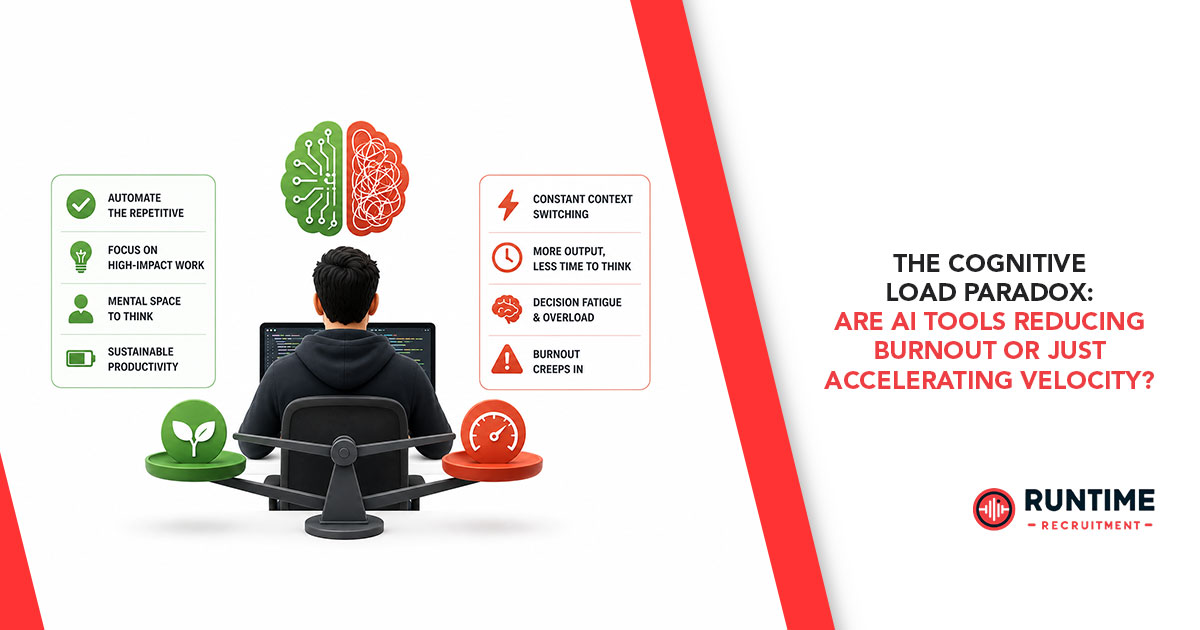
Introduction: The Unintended Consequence of Seamless Code Generation
The modern embedded systems engineering landscape is undergoing a tectonic shift. For decades, firmware developers and embedded hardware engineers operated under a steady rhythm dictated by datasheets, silicon errata, register maps, and strict hardware abstraction layers (HALs). Crafting low-level C or C++ code for microcontrollers, configuring direct memory access (DMA) controllers, and debugging real-time interrupt service routines (ISRs) required painstaking precision. A single misplaced bitwise operation could result in a hard fault, a silent memory corruption, or bricked hardware on the bench.
Then came generative AI and specialized developer assistants.
Tools like GitHub Copilot, Cursor, and domain-adapted large language models (LLMs) promised to liberate embedded engineers from tedious syntax, repetitive driver boilerplate, and boilerplate unit test construction. The initial pitch was enticing: reduce cognitive strain, automate repetitive taskwork, eliminate developer burnout, and restore focus to high-level architectural innovation and system integrity.
Yet, as these AI tools achieve widespread integration across development teams, an unexpected phenomenon has emerged—what industry veterans are calling The Cognitive Load Paradox.
Instead of feeling liberated, many embedded engineers report feeling more exhausted, perpetually rushed, and mentally drained. While AI assistants have undoubtedly accelerated line-by-line coding velocity, they have simultaneously compressed development cycles, elevated expectations for throughput, and shifted the primary engineering effort from authoring code to relentlessly auditing synthetic outputs.
This raises a crucial question for engineering leaders, firmware architects, and hardware teams: Are AI development tools actually reducing engineer burnout, or are they simply accelerating the treadmill of modern software velocity at the expense of human cognitive capacity?
The Anatomy of the Paradox: Shifting Cognitive Tax from Authoring to Auditing
To understand why AI assistants have not automatically translated into reduced burnout, one must analyze how the human brain processes software design in constrained environments.
In traditional embedded development, writing code is only a fraction of the actual workload. The process of writing a device driver—say, an I2C sensor interface or a SPI flash memory wrapper—forces the engineer to construct a comprehensive mental model of the system. The developer reads the component datasheet, traces signal timing diagrams, evaluates power modes, plans buffer allocation, and mentally simulates edge cases such as bus collisions or timeout handling.
When an engineer manually authors this code line by line, the mental model builds incrementally. The friction of typing syntax acts as a cognitive pacing mechanism. By the time the driver is written, the engineer possesses a deep, intuitive understanding of how the code interacts with the underlying silicon.
The Audit Strain in Deterministic Systems
AI code generators disrupt this organic mental synthesis. By outputting fifty lines of register-level configuration code in two seconds, the AI skips the incremental construction of the mental model. The engineer is immediately thrust into the role of a code auditor.
In high-level web or application development, auditing AI code might involve checking business logic or validating API calls—tasks where runtime isolation and garbage collection cushion errors. In embedded systems, however, code execution is intimately bound to deterministic real-time constraints and hardware state.
Auditing AI-generated firmware code requires an unnaturally high level of vigilance:
Deceptive Correctness: LLMs produce syntactically flawless C/C++ code that frequently looks elegant at first glance but contains subtle register configuration errors, unhandled race conditions, or unsafe memory accesses.
Hidden Timing Violations: AI generators often lack contextual awareness of real-time operating system (RTOS) task priorities, tick rates, and non-reentrant function calls, creating intermittent bugs that manifest only under specific load conditions.
Context Breakdown: Generated code may ignore subtle hardware errata or specific peripheral silicon limitations documented in obscure application notes.
Because synthetic code looks correct on the surface, auditing it requires more focus and critical scrutiny than writing code from scratch. The human brain must reverse-engineer the AI's logic while simultaneously holding the physical hardware context in memory. Rather than alleviating cognitive fatigue, the constant demand for critical verification imposes a continuous, high-intensity mental strain.
The Velocity Trap: Compressed Feedback Loops and the Loss of Cognitive Rest
Beyond the technical burden of code auditing lies a psychological mechanism known as The Velocity Trap, which is deeply tied to Jevons Paradox. Originally formulated in economics, Jevons Paradox states that as tech efficiency increases the resource cost of a production process, overall consumption of that resource actually rises rather than falls.
When applied to embedded software engineering, as AI makes the mechanical act of generating boilerplate code 50% faster, the organizational response is rarely to afford engineers 50% more rest or deeper reflection time. Instead, sprint capacities are expanded, delivery deadlines are pulled forward, and feature scopes are broadened.
+--------------------------------------------------------------------------------------+
| THE VELOCITY TRAP FEEDBACK LOOP |
| |
| [ AI Tools Adopted ] ---> [ Fast Boilerplate Generation ] |
| ^ | |
| | v |
| [ Higher Fatigue & ] <--- [ Tighter Deadlines & ] |
| [ Silent Tech Debt ] [ Broadened Feature Scope ] |
+-------------------------------------------------------------------------------------+
The Elimination of Micro-Breaks
In a traditional engineering workflow, the mechanical tasks—such as typing out data structures, formatting register definitions, writing verbose Makefile rules, or compiling local test runs—served an understated cognitive function. They provided micro-breaks. These brief moments of low-intensity intellectual effort allowed the developer’s brain to switch out of deep problem-solving mode, providing mental recovery throughout the workday.
With AI assistants constantly proposing autocomplete suggestions and entire function blocks, these natural cognitive breather intervals disappear. The developer is locked in a continuous, high-frequency decision loop:
Prompt the model.
Read the generated block.
Identify subtle flaws or hallucinations.
Refine the prompt or manually adjust the code.
Re-test on hardware.
Repeat immediately.
This uninterrupted sequence of rapid decision-making keeps the brain in a perpetual state of high context usage. Over an eight-hour shift, this accelerated feedback cycle exhausts mental reserves much faster than traditional, paced authoring, accelerating burnout despite metrics showing higher commit velocity.
The Friction Gap: Software Acceleration Meets Physical Hardware Reality
A unique reality for embedded systems engineers is that their code ultimately interfaces with physical silicon, board layouts, power delivery networks, and real-world environments. This creates what can be termed the Software-Hardware Friction Gap.
AI code generation tools are trained predominantly on digital software repositories. They excel at algorithmic transformations, string parsing, state machine skeletons, and standard protocol implementations. However, AI models possess zero physical intuition. They cannot measure signal integrity on an oscilloscope, observe ground bounce on an analog board, or feel a thermal throttling condition on a power MOSFET.
Where the AI Acceleration Wall Lives
+---------------------------------------------------------------------------------------------+
| THE EMBEDDED DEVELOPMENT SPECTRUM |
| |
| HIGH AI EFFICIENCY HUMAN INTUITION |
| [-------------------------------------------|-----------------------------------------------] |
| Generic Drivers RTOS Task Design Bus Arbitration Debugging |
| Algorithmic Math Memory Layouts Silicon Errata Workarounds |
| Test Skeletons State Machines Physical HW/SW Co-design |
+---------------------------------------------------------------------------------------------+
As a consequence, the embedded development workflow becomes highly asymmetrical:
Phase 1 (Rapid Acceleration): The initial software scaffolding, peripheral setup, and driver stubs are generated at lightning speed. Project momentum feels high during the first 20% of the timeline.
Phase 2 (The Hardware Friction Wall): When the code is deployed onto physical hardware or target microcontrollers, subtle hardware-software interaction issues surface—dangling pointers in DMA buffers, clock domain mismatches, or erratic interrupt preemption.
Because the early phases moved so fast, project managers and stakeholders often assume the project is nearly finished. When the engineering team subsequently spends weeks diagnosing a single hardware-level intermittent bus lockup that AI cannot solve, pressure mounts exponentially. The discrepancy between the rapid software output phase and the inherently slow physical debugging phase creates immense stress for embedded development teams.
Architectural Drift and Systemic Complexity
Another major contributor to cognitive burnout in AI-augmented teams is Architectural Drift.
When engineers rely heavily on AI generation, codebases tend to expand rapidly in volume. AI assistants naturally favor verbose, self-contained implementations over elegant, shared abstractions because self-contained snippets are easier to generate without global system context.
Over time, this introduces subtle architectural decay across embedded projects:
Fragmented Abstractions: Identical memory management logic or register access routines are rewritten in slightly different ways across multiple modules, inflating flash binary size and SRAM memory footprint.
Loss of Systemic Ownership: When developers assemble systems from AI-generated fragments without deeply crafting the underlying abstractions, no individual engineer possesses a complete mental map of the full system architecture.
Debugging Nightmares: When a system lockup, memory leak, or watchdog reset occurs in production, troubleshooting requires deep architectural familiarity. If that architecture was loosely assembled rather than systematically designed, tracing root causes becomes an agonizing, high-stress endeavor.
The technical debt generated by rapid, unvetted AI expansion must eventually be paid. The interest on that debt is collected in the form of late-night debugging sessions, urgent firmware patches, and engineering exhaustion.
Restoring Balance: Strategies for Managing Cognitive Load in the AI Era
AI development tools are not inherently harmful; they are extraordinarily powerful accelerators when deployed with clear boundary guidelines and intentional engineering culture. To prevent velocity tools from causing engineering burnout, leaders and development teams must recalibrate their operational paradigms.
1. Shift Metrics from Volume to Structural Health
Evaluating engineering team performance based on lines of code written, commit frequencies, or completed story points becomes counterproductive when AI tools are used. Teams should instead measure:
Test Coverage and Determinism: Verification quality over raw generation quantity.
Architectural Cleanliness: Maintaining strict static analysis compliance, low cyclomatic complexity, and minimal binary footprint.
Resolution Efficiency: How effectively the team root-causes edge-case failures on hardware target boards.
2. Establish Clear Boundaries for AI Deployment
Not all embedded code is suitable for AI assistance. High-performing engineering organizations establish explicit guidelines regarding where AI should and should not be used:
Approved for AI Generation: Standard protocol wrappers, unit test boilerplate, algorithm prototypes, documentation generation, and static data array definitions.
Restricted / Human-Only Authoring: Safety-critical state machines (e.g., ISO 26262, IEC 62304 compliant modules), low-level interrupt handlers, custom bootloaders, hardware security module (HSM) integrations, and core memory allocators.
3. Protect Deep Focus and Build-In "Pacing Protocols"
To combat the constant cognitive fatigue of rapid AI prompts, engineering managers must actively protect deep-work blocks. Encouraging engineers to manually architect core modules on whiteboards or paper before invoking AI tools ensures that the mental model is formed before synthetic code is generated, dramatically lowering the cognitive friction of auditing.
Conclusion: The Human Element in Embedded Excellence
The ultimate promise of engineering tools has always been to elevate human capability, not to turn engineers into high-speed code processors. In the constrained, high-precision domain of embedded systems engineering, AI tools are exceptional copilots, but they cannot replace the deep physical intuition, domain expertise, and rigorous architectural reasoning of skilled human engineers.
When managed thoughtfully, AI tools can eliminate tedious overhead and empower engineers to focus on complex embedded challenges. However, if unmanaged velocity becomes the primary objective, the cognitive load paradox will continue to drive talent burnout and undermine system reliability.
Balanced success lies in building engineering environments where cutting-edge tools serve human ingenuity—not the other way around.
Partner with RunTime Recruitment
Navigating the evolving landscape of embedded systems, firmware architecture, and hardware design requires exceptional talent and strategic vision. Whether you are an experienced embedded engineer seeking your next career-defining role or an engineering leader looking to recruit top-tier talent, RunTime Recruitment is your specialized partner.
Connect with RunTime Recruitment today to partner with specialist recruiters who understand the nuances of the embedded systems landscape.